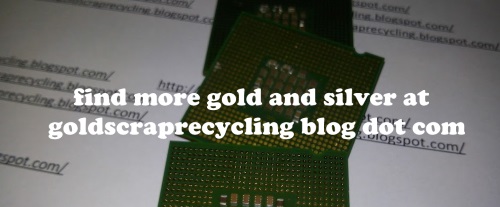

Does computer chips have 14krt gold inside them?

Are those little pins real solid gold?
You can get more gold out of a used computer
than gold ore (rocks with gold in them) compared by oz/weight. It is a good
idea to use gold because it is a great conductor (better than silver and
copper) and has the advantage of never corroding. It will never rust like iron
or turn green like copper.
There is also gold on the connector end of your cellphone (where the charger connects, ect).
There is also gold on the connector end of your cellphone (where the charger connects, ect).
They are plated gold, and they are more like
pure gold than 14K gold. There's not enough to even scrape them to get a small
pile of gold dust. They are like 0.001" thick, if even that. If they were
solid gold, there's no way a computer could cost $599. There's plated gold
plated on some connectors and card fingers too. Recyclers cut off the gold
fingers and the pins to reclaim the gold, but it takes a lot of boards and a
lot of processing.
The gold is there because they are a great electrical conductor and doesn't oxidize. Gold plating is also used in some solder plating because it adheres well to copper and solders really well.
The gold is there because they are a great electrical conductor and doesn't oxidize. Gold plating is also used in some solder plating because it adheres well to copper and solders really well.
On very few processors, they are pure. On
most, they are plated. You'd have to process thousands to get a decent amount
of gold.
There is gold in PC chips

Basically the phones are put into a vat, heated up and, at different temperatures, various metals are extracted. Other materials are burned off, in what I’m sure is an EPA-friendly operation. The return on operations is even greater than real gold mines! According to Yokohama Metal Company Limited (a recycling firm), a gold mine yields 1/5th ounce of gold for every ton of ore processed. With cell phones, 5.3 ounces of gold are yielded for every ton of cell phones processed, as well as 6.6 lbs of silver and 220 lbs of copper. At todays prices, that would be approximately $5,500 for the gold, $1,700 for silver and $870 for copper.
For every ton of discarded cell phones, the return on investment is $8,070 less the costs of processing, which are probably around 70%, meaning about $2,400 per ton, or $1.21/lb. Not bad at all.
Sell CPU for Gold
The processor (CPU: Central Processing Unit) is the brain of the PC. It contains millions to billions of microscopic transistors and a few hundred gold plated pins. Processors are one of the most value dense portions of the PC. Older processors are generally larger and have more generous gold plating than more modern ones: 386/486 and Pentium chips are particularly valuable.
You can recognize the processor as a large rectangular or square chip that plugs directly into the motherboard. It is usually the largest single chip in the PC. Intel and AMD are the largest PC processor manufacturers; however IBM, ARM, Motorola and others make them as well. The processor often has a heat sink attached to it which may also have a small fan. Heat sinks are typically aluminum, which has little scrap value.
Processors are also found in video cards (there they are called GPUs: Graphics Processing Units), in cell phones, iPods and iPads, and most other electronic devices. Generally only computer processors are large enough and detectable enough to merit separating them.
The value of the processor varies greatly depending on the model. As mentioned above, older processors generally have more precious metal content
Gold in electronic devices
Gold combination of high conductivity and resistance to corrosion has made the precious metal popular in electronic manufacturing process. The main use of gold in electronics has been with the plating of contacts in switches, relays, and connectors. Another of gold’s uses has been in electrical wiring for high-energy applications, but this is rare.
Gold is found in cell phones, calculators, PDAs, and GPS devices today. These gadgets are very common technologies used by people around the world. It is not hard for the contact points of these kinds of devices to get corroded. When tarnish or corrosion occurs, the low voltages and currents used in cell phones and PDA is broken up. Gold efficiently carries the current to these electronics and isn’t subject to the same corrosive wear other metals are.
About 50 cents of gold is used in each cell phone produced today. More often than not, that gold is not recovered from discarded cell phones. With an estimated one billion cell phones manufactured every year that is a large amount of gold that is being wasted. While we have been able with new technology to make gold thinner than ever, the increased number of new technologies has meant that our consumption of gold in electronics has not decreased.
How to Recycle Gold From a Computer?
Most older CPUs have gold components on
the circuit boards. Taking the whole board out is the first step. Open up the
case for your computer to access the electronics inside. You'll need a small
screwdriver for this step.
Take out the electronic components. Once
inside, you'll see the mother boards and memory chips. Pull out all the tasty
bits and lay in a bin. The case and other parts are also recyclable. Pack them
up separately for an environmentally responsible disposal.
Stock pile it. A study done by EOEarth
states: "1 metric ton (t) of electronic scrap from personal computers
(PC's) contains more gold than that recovered from 17 t of gold ore". One
computer won't have enough gold to make you rich. Yet, if you begin to collect
abandoned computers, you can save all your gold parts. This will make going
through the process of reverse electro plating it by the recycling center worth
the time and effort.
Separate your pieces. Most computer
recycling centers ask that you separate metals and plastics. Don't just focus
on the gold in your computer. Be sure to recycle the rest of the plastics and
electronics. To keep down clutter, immediately disassemble your old computers
and take all the plastics in for recycling immediately.
Take it in for recycling. You'll see that
your computer has all kinds of shiny metallics in it. Many of these metals are
also recyclable. Taking your PC to a computer recycle center is the easiest way
to retrieve your precious metals. You'll want to find a precious metals
refinery to send your circuit boards and chips to. They will do all the work,
and they'll give you a fair price for the efforts. See our website for more tips of how to recycle gold from electronic waste.
How to Recycle old CPU?
Research the different recycling programs that major computer companies have. Apple, Dell, Gateway and many others all have programs in place to help you deal with your electronic waste. Some companies even have a trade in program that allows you to use your old computer toward the purchase of a new one.
Find recycling companies who deal in electronics. If the company you bought your computer from doesn't have it's own recycling program, find one on your own. A simple computer or yellow page search will lead you to companies across the country such as E-Tech Recycling that can help.
On the other hand, ifyou want to do it yourself and earn some extra from Gold please take a look atthis link and find how to recycle electronic waste and extract gold from it.
Subscribe to:
Posts (Atom)