Introduction of computer recycling for Gold


Obsolete computers contain significant amounts of recoverable materials including metals from wires and circuit boards, glass from monitors, and plastics from casings (fig. 1). For example, 1 metric ton (t) of electronic scrap from personal computers (PC’s) contains more gold than that recovered from 17 t of gold ore. In 1998, the amount of gold recovered from electronic scrap in the United States was equivalent to that recovered from more than 2 million metric tons (Mt) of gold ore and waste.

The amount of computer waste increases annually as electronic systems play an increasingly important role in all aspects of technology, but significant amounts of material used in the devices are not recovered. Because microchip development is so rapid (Hamilton and Takahashi, 1996), users are able, every 18 months, to purchase computers that are twice as powerful at the same price as those currently available (Jung, 1999). This cyclic trend (with its inherent surplus of old computer components) has been sustained for nearly 20 years of recent computer history. To meet consumer demand, the computer and electronics industry has become the largest manufacturing employer in the United States, representing 11 percent of the gross domestic product and growing at an annual rate of 4 percent (Porter, 1998).

The quantities and types of materials used in computer products to meet this demand are great and varied, as is the potential to recover these computers and their materials for reuse, remanufacturing, and recycling. In 1998, nearly 43 million new PC’s and notebook computers were purchased by consumers in the United States; and it is estimated that in the year 2003, nearly 70 million computers will be purchased by consumers in the United States (National Safety Council, 1999).

In 1997, it was estimated that between 1985 and 2005, approximately 325 million PC’s would become obsolete in the United States (Jung, 1999). In a business environment, the useful life of a PC is about 2 years, while in homes PC’s are used from 3 to 5 years (Jung, 1999). Between 14 and 20 million PC’s become obsolete every year in the United States. About 75 percent of these obsolete computers are not discarded because their owners perceive them to be valuable (Goodrich, 1999); a portion of these will not be recycled. For every three computers purchased in the United States, two will be taken out of service, and this ratio is expected to increase to 1:1 by 2005. It is projected that by 2005, a total of 680 million PC’s will have been sold worldwide. Of that total, it is estimated that 150 million computers will be recycled that year and 55 million computers will end up in landfills along with unreclaimed portions of the 150 million recycled computers (Hamilton and Takahashi, 1996).

Recycling Flow


Figure 2 is a generalized materials flow diagram that shows what happens to obsolete PC’s and their components.

This figure includes

• computers that owners retain (but do not use) or donate or dispose of directly or indirectly to municipal waste and hazardous waste landfills (The U.S. Environmental Protection Agency (EPA) categorizes cathode ray tubes (CRT’s) as hazardous waste, although exemptions exist for disposal of equipment generated by households and small business.)

• computers that can be refurbished and sold or donated by companies or organizations

• what happens to computers that can be dismantled and sold for reuse, melted and recycled, incinerated as a fuel for producing energy, and disposed of in landfills.

Computers and otherelectronic devices represent a large resource of potentially recoverablematerial. Table 1 lists selected types and amounts of material reportedly recovered in 1997 and 1998 from computer and other electronic scrap. In 1998, about 2.6 million PC’s and notebook computers were recycled in the United States, and this number is expected to quadruple by 2003 (National Safety Council, 1999). Recyclers received nearly 50 percent of electronic products directly from manufacturers; about 30 percent from large companies that utilize electronics in their business; and the rest from small companies, government offices, and individuals (National Safety Council, 1999).

Some scrap is unwanted because of low precious metal content and the potentially hazardous nature of some of its materials. For example, the presence of lead in some electronic scrap prevents it from being placed in a municipal landfill. Some refiners actually have to charge as much as $1 per pound to process the scrap because of these deleterious materials (Broughton, 1996).

Some scrap was exported to Taiwan for open burning and chemical processing; however, the Taiwanese government had reportedly become increasingly concerned about the environmental damage caused by this practice (Broughton, 1996). Chinese and other Asian consumers pay 15 to 20 cents per pound for electronic scrap on the U.S. West Coast (Goodrich, 1999). Environmental regulations are less strict (or not enforced), and labor costs are much lower in some of these countries.
Gold recycling

Price Of Gold - Demand for Gold


The current price of gold is at an almost unprecedented high. In fact, the average price in 2011 is lower than only the price attained in 1980 in real terms.

Like most commodity prices, gold price experiences significant fluctuations. And as with all traded commodities, the price is determined by supply and demand. Shifts in supply arise mainly from new gold deposits in the various mines across the world. A major and fluctuating factor in demand for gold is the need for safe investment.

This means that the demand for gold tend to increase when the real rate of return on alternative investments falls. This usually occurs in periods when either the yield on benchmark securities (for example, the US treasury bonds or bill) falls significantly or when there are expectations of higher inflation.

For example, the high gold prices of the 1970s and early 1980s coincided with one of the highest global inflation period. During such periods, smaller shares of gold tend to be put to end uses such as jewelry and industry.
Read more about Gold and Gold recycling Gold recycling

Watch this great video of Gold precipitation on YouTube

This great video is showing of how to precipitate gold from Aqua regia. Solution on this video is a chloride, in which we can find Gold.


It is important to wear proper safety equipment when performing these chemical experiments.

Gold recycling

How gold selling works?

How gold selling works

Gold buying companies' business model is simple: they buy gold, melt it down and flog it on for more. This means you can get cold hard cash for broken and unloved bling.
There are two main ways to flog your gold…
  1. Postal gold companies.
    With postal gold websites, you get a quote and send it off in an envelope. Payment is by cheque or direct into your account. When some gold sites send a cheque, you can choose to cash it or reject it. Gold sites' feedback varies dramatically, so read this guide carefully before posting your treasures.
  2. On the high street.
    If it's high street gold jewellers, you simply go door to door, haggle and hand over the goods there and then. This is safe and you'll know exactly how much you'll get, but, unless you live near London or Birmingham's jewellery quarters, postal gold often wins.
There are also gold parties, where friends get together to flog jewellery. We asked one of the biggest gold party firms what it pays per gram, but it wouldn't say. Ultimately, you're likely to get enjoyably inebriated – but that's never the best way to make a financial transaction.
This article will help you get the most ker-ching! for your bling and show you how to do it right. But remember... Read more on GoldinPC Gold recycling

How many gold chip from a pc does it take to get an ounce?


Gold recycling

Does computer chips have 14krt gold inside them?

Are those little pins real solid gold?


You can get more gold out of a used computer than gold ore (rocks with gold in them) compared by oz/weight. It is a good idea to use gold because it is a great conductor (better than silver and copper) and has the advantage of never corroding. It will never rust like iron or turn green like copper.

There is also gold on the connector end of your cellphone (where the charger connects, ect).

They are plated gold, and they are more like pure gold than 14K gold. There's not enough to even scrape them to get a small pile of gold dust. They are like 0.001" thick, if even that. If they were solid gold, there's no way a computer could cost $599. There's plated gold plated on some connectors and card fingers too. Recyclers cut off the gold fingers and the pins to reclaim the gold, but it takes a lot of boards and a lot of processing.

The gold is there because they are a great electrical conductor and doesn't oxidize. Gold plating is also used in some solder plating because it adheres well to copper and solders really well.

On very few processors, they are pure. On most, they are plated. You'd have to process thousands to get a decent amount of gold.
Gold recycling

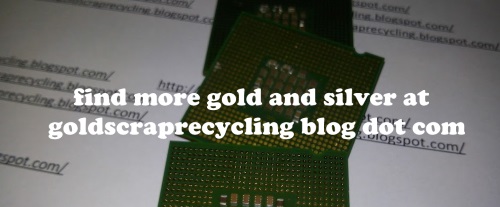
There is gold in PC chips


There’s gold, silver, copper and several other precious metals inside the chip components that make the cell phones, computers and other electronic devices to work. They’re introduced during the manufacturing phase to connect circuits, complete wiring, etc. They’re present in very small quantities, but if you take many hundreds of recycled cell phones and melt them down you’d come away with a fairly large quantity of gold, a larger quantity of silver, and even still larger quantity of copper, though in terms of value it would be the other way around.

Basically the phones are put into a vat, heated up and, at different temperatures, various metals are extracted. Other materials are burned off, in what I’m sure is an EPA-friendly operation. The return on operations is even greater than real gold mines! According to Yokohama Metal Company Limited (a recycling firm), a gold mine yields 1/5th ounce of gold for every ton of ore processed. With cell phones, 5.3 ounces of gold are yielded for every ton of cell phones processed, as well as 6.6 lbs of silver and 220 lbs of copper. At todays prices, that would be approximately $5,500 for the gold, $1,700 for silver and $870 for copper.

For every ton of discarded cell phones, the return on investment is $8,070 less the costs of processing, which are probably around 70%, meaning about $2,400 per ton, or $1.21/lb. Not bad at all.
Gold recycling